The Hidden Shift in B2B Search How Professional Content Feeds the AI Ecosystem
HyppeSocial May 21st, 2026 Social Media Marketing
The New Frontier of B2B Discovery
Traditional search engines are no longer the sole gatekeepers of business information. A significant shift is occurring in how decision-makers find answers, moving away from a list of blue links and toward direct, conversational responses provided by artificial intelligence. Recent industry data reveals that professional social platforms have become a primary source of truth for these AI models.
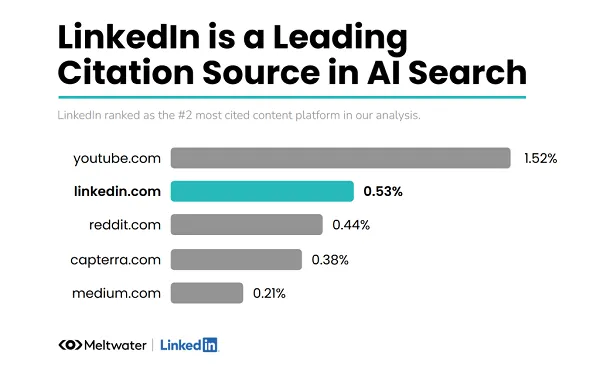
One specific network is now the second most-cited domain across the major AI chatbot models. When a user asks an AI for business advice, industry trends, or strategic frameworks, the platform providing the source material is increasingly likely to be a professional network rather than a traditional news site or a corporate blog. This transition represents a fundamental change in generative engine optimization.
AI models prioritize these networks because they are built on a foundation of verified identities and real-world expertise. Unlike the open web, which is cluttered with anonymous SEO-driven content, professional networks offer a repository of insights from individuals with documented careers and peer-validated skills. This credibility makes the content irresistible to large language models seeking authoritative data.
Why Personal Profiles Outperform Corporate Pages
Data from over nine million AI citations indicates a clear preference in how bots select their sources. Content published by individual users is cited significantly more often than updates shared by corporate company pages. This suggests that AI algorithms are programmed to value human experience over polished marketing copy.
AI models look for content written by credible practitioners who share specific domain expertise. They are searching for examples, data points, and nuanced details that only a professional in the field can provide. A company update often feels like a press release, whereas a personal post feels like a lesson learned. The bots have learned to tell the difference.
For organizations looking to increase their visibility in AI-generated answers, the strategy must pivot toward employee advocacy. By empowering internal subject matter experts to share their knowledge publicly, a brand can effectively infiltrate the AI response loop. The authority of the individual becomes the primary driver for the brand’s visibility in the chatbot era.
The Mechanics of Generative Engine Optimization
Structural clarity is the most important factor in whether a piece of content gets cited by an AI. Analysis of high-performing posts shows that 83% of all citations come from two specific formats: long-form articles and plain-text updates. This is a sharp departure from the video-first trends seen on consumer social media platforms.
To be cited, content must be easy for a machine to parse. The most successful posts share several common structural elements:
- The use of clear, descriptive headings that signal the topic of each section.
- Heavy reliance on bulleted or numbered lists to organize complex information.
- Direct language that avoids unnecessary metaphors or flowery prose.
- A focus on specific, data-backed claims rather than vague generalizations.
Nearly every top-cited article in recent studies utilized a hierarchical structure. This allows an AI model to extract specific segments to answer direct user queries accurately. If your content is buried in an image or a poorly structured PDF, it effectively does not exist for a chatbot.
Dominating the B2B Knowledge Graph
The impact of this professional content is most visible in specialized B2B sectors. In industries like digital marketing, finance, and enterprise technology, professional network citations rank in the top five sources across the board. When someone asks a chatbot about attribution models or software-as-a-service trends, the answer is often pulled directly from a practitioner's post.
This creates a self-reinforcing cycle of authority. As AI models continue to cite the same experts, those individuals gain more visibility, leading to more engagement and more data for the models to ingest. Staying ahead of this curve requires a consistent commitment to publishing high-value, structured text that addresses the specific pain points of a target audience.
The future of search is conversational, but the sources remain human. By focusing on deep expertise and logical formatting, professionals can ensure their insights remain at the center of the AI-driven information economy. The goal is no longer just to rank on page one, but to be the footnote that powers the AI’s answer.