Translated Sites Boost AI Overview Visibility by 327%
HyppeSocial November 16th, 2025 SEO
The landscape of search engine optimization (SEO) has evolved significantly with the introduction of AI Overviews and the growing influence of large language models (LLMs). As these AI-powered features curate and summarize search results, a critical question for SEO professionals is how websites can maintain and enhance their visibility, particularly across different languages.
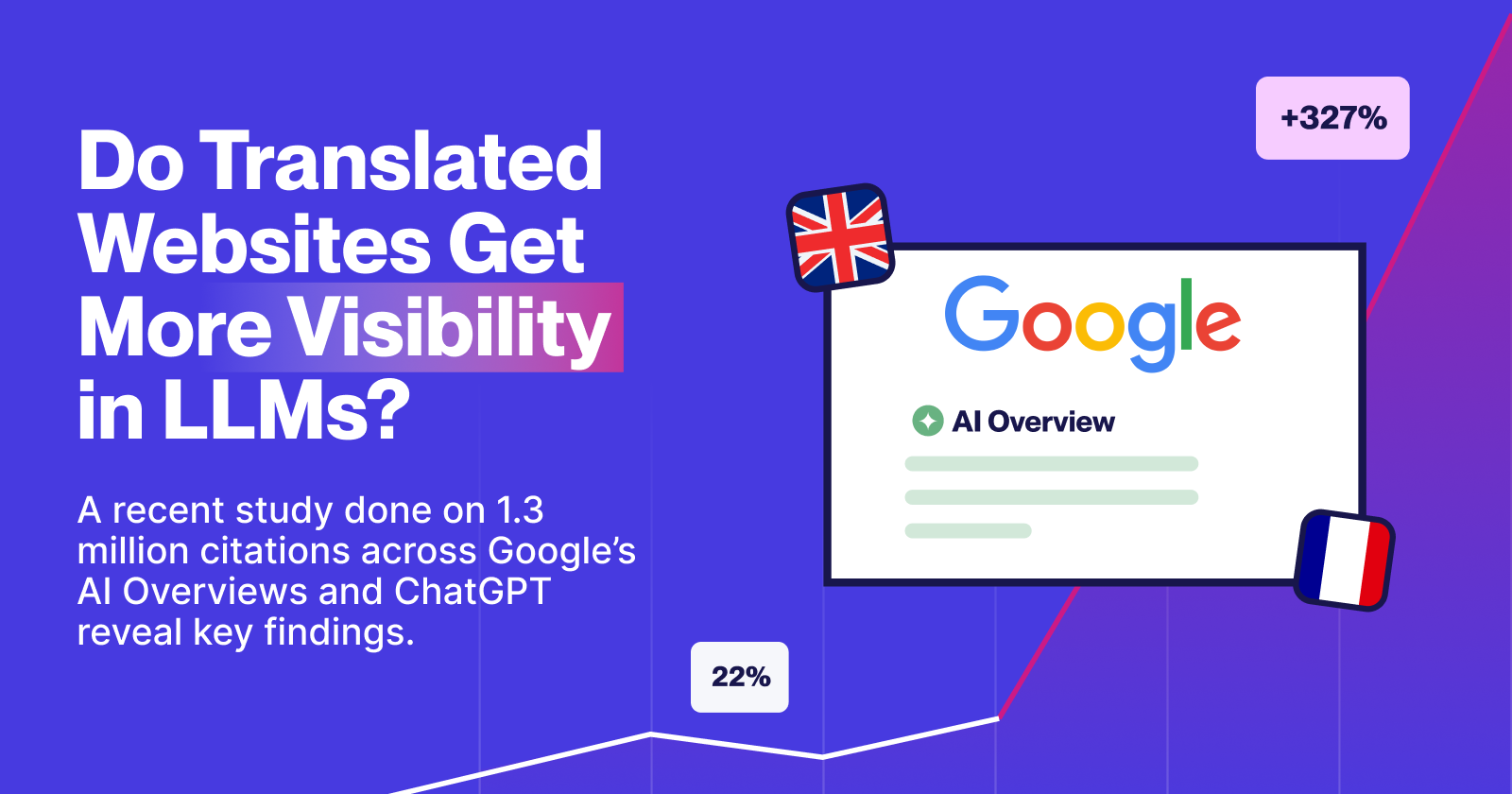
Recent research indicates a clear answer: translated sites achieve substantially greater visibility in AI Overviews compared to their untranslated counterparts. A study analyzing 1.3 million citations across Google AI Overviews and ChatGPT revealed that websites with translated content saw an increase of up to 327% in visibility. This finding strongly suggests that international SEO and content translation are now essential components of any successful AI search strategy for 2026 and beyond.
Beyond simply making content available in multiple languages, the study also found that websites offering an additional language were more likely to be cited in AI Overviews, irrespective of the search query's language. This implies that the presence of multilingual content itself signals authority and relevance to AI systems, leading to broader visibility.
Understanding the Shift in AI Search Dynamics
The emergence of AI Overviews and large language models (LLMs) fundamentally alters how users discover information online. Instead of solely relying on traditional ranked search results, these AI systems generate concise summaries and answers, citing sources from across the web. This shift redefines the criteria for visibility: instead of merely ranking a page, AI now 'cites' content within its generated responses.
This new dynamic introduces a significant consideration for website owners: if your content is not available in the user's search language, there is a risk that AI systems might overlook it entirely. A more problematic scenario is when users are directed to a proxy page like Google Translate's, which handles the translation but deprives the original site of direct traffic and engagement benefits. Such proxy pages offer no control over translation quality and do not attribute traffic to the original source, making direct website translation a superior strategy for maintaining brand presence and user experience.
The Weglot Study: Unpacking the Methodology
To quantify the impact of translation on AI visibility, Weglot conducted a comprehensive data-driven study, focusing on Spanish-language websites across two distinct markets: Spain and Mexico. The research was systematically divided into two phases to allow for a direct comparison between translated and untranslated content.
In Phase One, the study examined 153 untranslated websites (98 from Spain and 55 from Mexico). These sites were deliberately chosen for their high traffic volume but notable absence of English versions. This allowed researchers to isolate the performance of content available solely in Spanish.
Phase Two introduced a comparison group consisting of 83 Spanish and Mexican websites that had both Spanish and English versions. This setup enabled a direct assessment of how the presence of translated content influenced AI search visibility.
The methodology involved converting the top 50 non-branded keywords for each website into user-query equivalents. These queries were then translated between Spanish and English versions to simulate real-world search behavior. Cumulatively, this rigorous process generated 22,854 queries in Phase One and 12,138 in Phase Two, resulting in an analysis of 1.3 million citations from Google AI Overviews and ChatGPT.
Untranslated Sites: Limited AI Search Visibility
The study's findings highlight a substantial decrease in visibility for untranslated websites when searches are conducted in languages not available on the site. Despite strong performance in their native language, these sites experienced a dramatic drop in citations for queries in other languages.
For instance, among the 98 untranslated sites from Spain, there were 17,094 citations for Spanish queries. However, for the equivalent searches performed in English, these sites received only 2,810 citations. This represents a significant 431% gap in AI Overview visibility.
A similar pattern was observed with untranslated Mexican websites: 12,038 citations for Spanish queries contrasted with 3,450 citations for English queries, indicating a 213% reduction in citations when the search was made in English. Even in ChatGPT, which showed slightly more balanced results, Spanish sites received 3.5% fewer citations in English, and Mexican sites saw a 4.9% reduction.
This data confirms that untranslated content severely limits a website's reach within AI search environments, essentially making it invisible to users searching in non-native languages. The risk of losing potential traffic and engagement becomes evident, underscoring the necessity of a multilingual approach.
Translated Sites: A Significant Boost in AI Search Visibility
In stark contrast, websites that offered translated versions dramatically closed the visibility gap. The comparison group of Spanish websites with an English version demonstrated a transformative increase in visibility within Google AI Overviews.
For translated sites in Spain, the study recorded 10,046 citations for Spanish queries versus 8,048 for English queries, narrowing the visibility gap to just 22%. Similarly, translated Mexican sites showed 5,527 citations for Spanish queries and 3,325 for English, with a difference of 59%.
Overall, translated sites achieved 327% more visibility than untranslated ones and secured 24% more total citations per query. Furthermore, the bias observed in ChatGPT for untranslated content nearly vanished for translated sites, which received almost equal citations in both languages.
These results provide compelling evidence that content translation is not merely an optional addition but a strategic imperative for businesses aiming to maximize their global online presence in the era of AI search.
Practical Steps for Implementing Multilingual SEO in 2026
Translating a website involves more than just converting text; it requires a strategic approach to multilingual SEO. Here are practical steps to effectively implement translated content and enhance your AI search visibility:
- Conduct a Thorough Language Audit: Evaluate your current website's language capabilities and identify which languages are essential for reaching your target international audiences. Consider market demand, competitor analysis, and geographical relevance.
- Choose the Right Translation Strategy:
- Manual Translation: Ideal for high-value, sensitive content where nuance and brand voice are critical. Ensures maximum accuracy and cultural relevance.
- Automated Translation with Human Review: A scalable solution for larger sites. AI-powered translation tools can provide a strong first pass, followed by professional human editors to refine for accuracy, tone, and cultural appropriateness.
- Hybrid Approaches: Combine the speed of automation for bulk content with human expertise for key pages (e.g., product descriptions, legal disclaimers, marketing copy).
- Implement Technical Multilingual SEO Best Practices:
- Hreflang Tags: Properly implement hreflang tags to signal to search engines the language and geographical targeting of your pages, preventing duplicate content issues.
- URL Structure: Decide on a consistent and SEO-friendly URL structure (e.g., subdomains like
es.example.com, subdirectories likeexample.com/es/, or country-specific top-level domains likeexample.es). - XML Sitemaps: Include all translated URLs in your XML sitemaps to ensure they are discoverable by search engines.
- Server Location (Optional): For specific geographical targeting, consider using Content Delivery Networks (CDNs) or local servers to improve loading times for international users.
- Localize Beyond Translation: True international SEO goes beyond word-for-word translation.
- Keyword Research: Conduct localized keyword research for each target language and region. Keywords often differ significantly in usage and intent across cultures.
- Content Adaptation: Adapt content to suit local cultural norms, preferences, and legal requirements. This might involve adjusting images, examples, currencies, date formats, and calls to action.
- Local SEO Elements: For businesses with physical locations, ensure local business listings (e.g., Google Business Profile) are optimized for each target country/language.
- Monitor and Adapt: Regularly monitor the performance of your translated content using analytics tools. Track organic traffic, AI Overview citations, user engagement metrics, and conversion rates for each language. Be prepared to refine your translation strategy and content based on performance data and evolving AI search trends.
AI Search Rewards Translated Content as a Visibility Signal
In the new era of AI-driven search, multilingual content is more than just a means to reach global audiences; it functions as a crucial visibility signal. While traditional international SEO focused on elements like hreflang tags and localized keywords, the presence of translated content itself now contributes to a website's perceived authority and relevance in AI Overviews and LLMs.
This increased visibility stems from several factors:
- Language Alignment: AI engines prioritize content that directly matches the language of the user's query. Translated versions ensure this alignment, making your site a direct candidate for citation.
- Authority Building: Websites with comprehensive multilingual offerings are often perceived by AI systems as more authoritative and reliable sources. The effort invested in providing content in multiple languages signals a broader commitment to serving diverse user needs, which can positively influence citation performance across all languages. The study found that translated sites received 24% more citations per prompt than untranslated sites, with a 33% increase in English citations and a 16% increase in Spanish citations per query.
- Traffic Control: By providing official translations, websites prevent search engines from defaulting to less optimal solutions like Google Translate proxies, ensuring that users are directed to your owned, branded content.
- Semantic Reach: Multilingual content naturally expands a website's semantic footprint, allowing it to be relevant for a wider array of queries and topics across different linguistic contexts. This broadened reach enhances the likelihood of AI systems recognizing and citing the content.
Conclusion: Multilingual Strategies Are Essential for AI Search in 2026
The data from the Weglot study unequivocally demonstrates the power of translated sites in securing and enhancing visibility within AI Overviews and other large language models. With a remarkable 327% increase in visibility, coupled with broader citation performance across all languages, the message for SEO professionals is clear: a robust multilingual strategy is no longer optional for global reach; it is fundamental for relevance in the evolving AI search landscape of 2026.
As AI continues to mediate how information is discovered, investing in professional content translation and comprehensive international SEO practices will be a decisive factor in maintaining and growing your digital presence worldwide. Untranslated sites risk significant loss of visibility, making multilingual content a core pillar of future-proof SEO strategies.